Student loan debt has become a pervasive reality for millions of Americans, casting a long shadow over their financial futures. The weight of this debt can be overwhelming, leaving borrowers feeling trapped and uncertain about their path to financial freedom.
Understanding the various repayment options available is crucial for navigating this complex landscape and finding a solution that aligns with your individual circumstances.




This comprehensive guide delves into the intricacies of student loan repayment, providing a roadmap to help you make informed decisions and effectively manage your debt. From standard repayment plans to income-driven options and loan consolidation strategies, we’ll explore the spectrum of choices available to you, empowering you to take control of your financial future.
Standard Repayment Options
The standard repayment plan is the most common repayment option for federal student loans. This plan offers a fixed monthly payment over a set period, typically 10 years.
Obtain direct knowledge about the efficiency of Parent PLUS loans through case studies.
Standard Repayment Plan Overview
The standard repayment plan is designed for borrowers who want a predictable and straightforward repayment schedule. This plan involves making fixed monthly payments for a set period, typically 10 years, to repay the loan in full. The monthly payment amount is calculated based on the total loan amount, the interest rate, and the repayment term.
Pros and Cons of the Standard Repayment Plan
The standard repayment plan has its advantages and disadvantages.
Advantages
- Predictable Monthly Payments:Borrowers can budget their finances effectively with a fixed monthly payment amount.
- Shortest Repayment Term:This plan offers the shortest repayment period, allowing borrowers to pay off their loans faster and reduce the total interest paid.
- Lower Interest Costs:The shorter repayment term leads to lower overall interest costs compared to other repayment plans.
Disadvantages
- Higher Monthly Payments:Fixed monthly payments can be higher than other repayment plans, potentially straining borrowers’ budgets.
- Limited Flexibility:The standard repayment plan offers limited flexibility in terms of adjusting payments or extending the repayment term.
- Potential for Negative Amortization:If the monthly payment is less than the accrued interest, the loan balance could increase over time, leading to negative amortization.
Comparison with Other Repayment Plans
The standard repayment plan can be compared with other options to determine the most suitable plan based on individual circumstances.
| Repayment Plan | Monthly Payment | Repayment Term | Pros | Cons |
|---|---|---|---|---|
| Standard Repayment | Fixed | 10 years | Predictable payments, shortest repayment term, lower interest costs | Higher monthly payments, limited flexibility, potential for negative amortization |
| Graduated Repayment | Starts low, gradually increases | 10 years | Lower initial payments, more affordable in early career stages | Higher payments later, potentially less manageable |
| Income-Driven Repayment (IDR) | Based on income | 20 or 25 years | Lower monthly payments, based on income, potential for loan forgiveness | Longer repayment term, higher total interest costs, potential for negative amortization |
| Extended Repayment | Fixed | Up to 25 years | Longer repayment term, lower monthly payments | Higher total interest costs, longer repayment period |
Income-Driven Repayment Plans
Income-driven repayment plans (IDRs) are designed to make student loan repayment more affordable by basing your monthly payments on your income and family size. These plans are particularly beneficial for borrowers with lower incomes or high debt balances, as they can significantly reduce your monthly payments and potentially lead to loan forgiveness after a certain period.
IDR Plan Options
There are several IDR plans available, each with its own specific features and eligibility requirements. These plans offer a flexible approach to repayment, allowing borrowers to manage their student loan debt while focusing on other financial goals.
- Income-Based Repayment (IBR): This plan caps your monthly payment at 10% of your discretionary income (income exceeding 150% of the poverty guideline for your family size). The remaining balance may be forgiven after 20 or 25 years of payments, depending on when you took out your loans.
- Pay As You Earn (PAYE): PAYE also caps your monthly payment at 10% of your discretionary income. However, it offers a more generous forgiveness timeline, with the potential for forgiveness after 20 years of payments for loans taken out after July 1, 2014, or after 25 years for loans taken out before that date.
- Revised Pay As You Earn (REPAYE): REPAYE caps your monthly payment at 10% of your discretionary income, but unlike IBR and PAYE, it includes both undergraduate and graduate loans. Forgiveness is available after 20 or 25 years of payments, depending on when you took out your loans.
- Income-Contingent Repayment (ICR): ICR sets your monthly payment at a percentage of your discretionary income, calculated as a fraction of your total monthly income based on your loan balance and repayment period. Forgiveness is available after 25 years of payments.
IDR Plan Comparisons
| Plan | Payment Calculation | Forgiveness Eligibility | Other Features |
|---|---|---|---|
| IBR | 10% of discretionary income (income exceeding 150% of poverty guideline) | 20 or 25 years, depending on loan origination date | Available to borrowers who took out loans before July 1, 2014 |
| PAYE | 10% of discretionary income | 20 years for loans taken out after July 1, 2014, 25 years for loans taken out before that date | Available to borrowers who took out loans after October 1, 2007 |
| REPAYE | 10% of discretionary income | 20 or 25 years, depending on loan origination date | Includes both undergraduate and graduate loans |
| ICR | Percentage of discretionary income based on loan balance and repayment period | 25 years | Available to borrowers who took out loans before July 1, 2014 |
Benefits of Income-Driven Repayment Plans
- Lower Monthly Payments: IDRs can significantly reduce your monthly payments, making student loan repayment more manageable. This can free up cash flow for other financial priorities like saving for retirement or paying down other debts.
- Potential for Loan Forgiveness: After a certain period of payments, typically 20 or 25 years, your remaining loan balance may be forgiven. This can provide significant financial relief and help you achieve financial freedom.
- Flexibility: IDRs adjust your monthly payments based on your income, providing flexibility during periods of unemployment or reduced earnings. This can help you avoid defaulting on your loans.
Drawbacks of Income-Driven Repayment Plans
- Longer Repayment Periods: IDRs generally have longer repayment periods than standard repayment plans, which can result in paying more interest over the life of the loan.
- Potential for Higher Interest Accrual: Although your monthly payments are lower, you may accrue more interest over time due to the longer repayment period.
- Tax Implications: Forgiven loan balances are typically considered taxable income.
Loan Consolidation and Refinancing
Loan consolidation and refinancing are two strategies that can help borrowers manage their student loan debt. While both options involve combining multiple loans into a single one, they differ in their mechanics and potential benefits.
Loan Consolidation
Loan consolidation involves combining multiple federal student loans into a single new loan with a new interest rate. The new interest rate is a weighted average of the interest rates on the original loans, rounded up to the nearest one-eighth of one percent.
Consolidation does not change the amount of debt owed, but it can simplify repayment by reducing the number of monthly payments.
Advantages of Loan Consolidation
- Simplified Repayment:Consolidating multiple loans into one simplifies the repayment process by reducing the number of monthly payments and making it easier to track loan balances.
- Potential for Lower Monthly Payments:While the overall amount of debt remains the same, consolidation can sometimes result in lower monthly payments, especially if the new interest rate is lower than the average of the original loans.
- Eligibility for Income-Driven Repayment Plans:Consolidating federal loans can make borrowers eligible for income-driven repayment plans, which can significantly reduce monthly payments based on income.
Disadvantages of Loan Consolidation
- No Reduction in Interest Rate:The new interest rate is a weighted average of the original loans, which may not be significantly lower than the highest interest rate among the original loans.
- Loss of Loan Forgiveness Benefits:Consolidating certain federal loans, such as Perkins Loans, can result in the loss of loan forgiveness benefits associated with those loans.
- Resetting the Loan Clock:Consolidating federal loans resets the loan clock, meaning the repayment period starts over from zero. This can lengthen the overall repayment period and increase the total interest paid.
Loan Refinancing
Loan refinancing involves replacing existing student loans with a new loan from a private lender. This process typically results in a lower interest rate, which can lead to lower monthly payments and a shorter repayment period.
Advantages of Loan Refinancing
- Lower Interest Rate:Private lenders often offer lower interest rates than federal student loan programs, especially for borrowers with good credit scores.
- Lower Monthly Payments:A lower interest rate can lead to lower monthly payments, making it easier to manage student loan debt.
- Shorter Repayment Period:With a lower interest rate, borrowers can often pay off their loans faster, saving on interest payments over the long term.
Disadvantages of Loan Refinancing
- Loss of Federal Loan Benefits:Refinancing federal loans with private loans can result in the loss of federal loan benefits, such as income-driven repayment plans, loan forgiveness programs, and deferment options.
- Credit Score Requirements:Private lenders typically have stricter credit score requirements than federal loan programs, which may make it difficult for some borrowers to qualify for refinancing.
- Variable Interest Rates:Some private loans offer variable interest rates, which can fluctuate over time and lead to higher monthly payments.
Factors to Consider When Choosing Between Consolidation and Refinancing
| Factor | Consolidation | Refinancing |
|---|---|---|
| Loan Type | Federal loans | Federal or private loans |
| Interest Rate | Weighted average of original loans | Potentially lower than original loans |
| Loan Benefits | Preserves federal loan benefits | May lose federal loan benefits |
| Credit Score Requirements | None | Typically requires good credit score |
| Repayment Period | Resets the loan clock | May shorten repayment period |
Public Service Loan Forgiveness (PSLF)
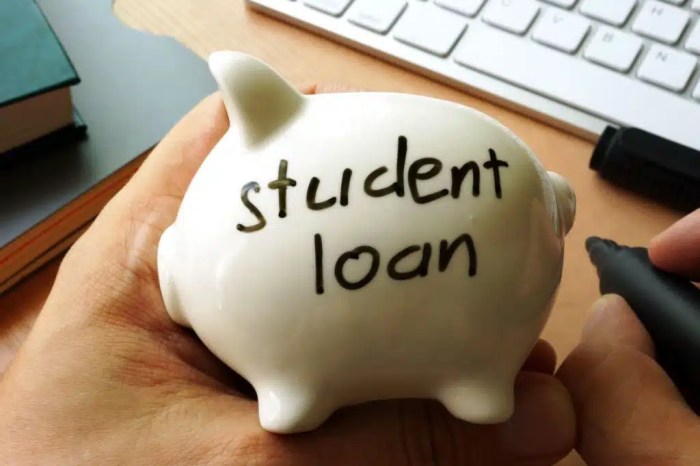
The Public Service Loan Forgiveness (PSLF) program is a federal program that forgives the remaining balance on your Direct Loans after you’ve made 120 qualifying monthly payments while working full-time for a qualifying employer. This program is designed to encourage individuals to pursue careers in public service, such as teaching, nursing, or law enforcement.
Eligibility Requirements for PSLF
To be eligible for PSLF, you must meet the following requirements:
- Have Direct Loans. PSLF only applies to Direct Loans, not Federal Family Education Loans (FFEL) or Perkins Loans. You can consolidate your FFEL or Perkins Loans into Direct Loans to become eligible for PSLF.
- Work full-time for a qualifying employer. Qualifying employers include government organizations (federal, state, or local), non-profit organizations, and certain types of private organizations.
- Make 120 qualifying payments. Qualifying payments are made on time while working full-time for a qualifying employer.
- Have a qualifying repayment plan. You must be enrolled in a qualifying repayment plan, such as the Income-Based Repayment (IBR) plan, the Pay As You Earn (PAYE) plan, or the Revised Pay As You Earn (REPAYE) plan.
Potential Benefits of PSLF
The potential benefits of PSLF include:
- Loan forgiveness. After making 120 qualifying payments, the remaining balance on your Direct Loans will be forgiven.
- Reduced monthly payments. Income-driven repayment plans, which are required for PSLF, can lower your monthly payments.
- Financial stability. PSLF can help you achieve financial stability by eliminating student loan debt.
Potential Challenges of PSLF
There are several potential challenges associated with PSLF:
- Complex application process. The PSLF application process can be complex and time-consuming.
- Strict eligibility requirements. The eligibility requirements for PSLF are strict, and many borrowers may not meet all of the requirements.
- Potential for program changes. The PSLF program is subject to change, and it is important to stay up-to-date on any program changes.
Step-by-Step Guide for Applying for PSLF
Here is a step-by-step guide for applying for PSLF:
- Consolidate your loans (if necessary).If you have FFEL or Perkins Loans, you will need to consolidate them into Direct Loans to be eligible for PSLF.
- Enroll in a qualifying repayment plan.You must be enrolled in a qualifying repayment plan, such as the IBR, PAYE, or REPAYE plan.
- Work full-time for a qualifying employer.You must work full-time for a qualifying employer, such as a government organization, non-profit organization, or certain types of private organizations.
- Submit an Employment Certification Form.You will need to submit an Employment Certification Form to the Department of Education every year to confirm that you are working full-time for a qualifying employer.
- Track your progress.It is important to track your progress towards PSLF by keeping a record of your qualifying payments.
- Submit a PSLF application.After you have made 120 qualifying payments, you can submit a PSLF application to the Department of Education.
Note:The PSLF program has been subject to changes in recent years, so it is important to stay up-to-date on any program changes. You can find the most current information on the Department of Education’s website.
Outcome Summary
Navigating the world of student loan repayment can feel daunting, but armed with knowledge and a proactive approach, you can effectively manage your debt and pave the way for a brighter financial future. Remember, there are resources available to support you along the way, including financial counselors and government programs.
By taking the time to understand your options and developing a personalized repayment strategy, you can alleviate the burden of student loan debt and achieve your financial goals.