The student loan crisis in the United States has reached a boiling point, with millions of borrowers struggling under the weight of mounting debt. The average borrower owes over $37,000, and the total amount of student loan debt outstanding has surpassed $1.7 trillion.
This burden is not only weighing down individuals but also hindering economic growth and fueling social inequality.



In response to this crisis, the Biden administration has proposed a plan to forgive a significant portion of student loan debt, sparking a heated debate about the merits and drawbacks of such a policy. This article will delve into the complexities of student loan forgiveness, examining its potential benefits and risks, and exploring alternative solutions to address the growing student loan burden.
The Student Loan Crisis
The student loan crisis in the United States is a pressing issue affecting millions of borrowers. The rising cost of higher education, coupled with stagnant wages, has led to an unprecedented surge in student loan debt, placing a significant burden on borrowers and the overall economy.
The Current State of the Student Loan Crisis
The student loan crisis is characterized by the increasing number of borrowers, the growing average loan amount, and the alarmingly high default rates. The total outstanding student loan debt in the United States has reached astronomical levels, exceeding $1.7 trillion.
This represents a significant increase from the early 2000s, when the total outstanding student loan debt was less than $500 billion.
Reasons for Rising Student Loan Debt
Several factors have contributed to the rising student loan debt burden in the United States. These include:
- Rising Tuition Costs: College tuition and fees have been increasing at a rate faster than inflation for several decades. This has made it increasingly difficult for students to afford a college education without taking out loans.
- Stagnant Wages: While the cost of education has risen, wages have not kept pace, making it more challenging for graduates to repay their loans. This gap between education costs and earning potential has exacerbated the student loan crisis.
- Easy Access to Loans: The federal government has made student loans readily available, making it easier for students to borrow large sums of money. This has contributed to the overall increase in student loan debt.
- Limited Financial Aid: The availability of grants and scholarships has not kept pace with the rising cost of college. This has forced many students to rely heavily on loans to finance their education.
Statistics on Student Loan Borrowers
- Number of Borrowers: As of 2023, over 45 million Americans have outstanding student loan debt. This represents a significant portion of the population, and the number of borrowers continues to grow.
- Average Loan Amount: The average student loan debt per borrower is over $37,000. This figure has been steadily increasing over the past decade, reflecting the rising cost of education and the growing reliance on loans.
- Default Rates: The student loan default rate has been a concern for many years. While it has declined in recent years, it remains a significant problem for borrowers and the economy. According to the U.S. Department of Education, the default rate for federal student loans was 10.1% in 2022.
Student Loan Forgiveness Programs
Student loan forgiveness programs offer a lifeline to borrowers struggling to repay their loans. These programs provide various ways to reduce or eliminate student loan debt, depending on factors such as employment, income, and loan type. While these programs offer hope, understanding their eligibility criteria and limitations is crucial.
Public Service Loan Forgiveness (PSLF)
This program forgives the remaining balance of federal direct loans after 120 qualifying payments made while working full-time for a qualifying employer.
- Eligibility Criteria:
- Work full-time for a qualifying employer (government, non-profit, or certain public service organizations)
- Have a Direct Loan program loan (not Federal Family Education Loan (FFEL) or Perkins Loans)
- Make 120 qualifying payments under a qualifying repayment plan (e.g., Income-Based Repayment (IBR), Pay As You Earn (PAYE), Revised Pay As You Earn (REPAYE), Income-Contingent Repayment (ICR))
- Limitations:
- Strict eligibility requirements, including the type of employer and repayment plan
- Potential for errors in tracking payments, which can lead to delays or denials
- Limited guidance and communication from loan servicers, which can lead to confusion and frustration
Income-Driven Repayment (IDR) Plans
IDR plans base monthly payments on a borrower’s income and family size. After a certain period (typically 20 or 25 years), any remaining balance is forgiven.
- Eligibility Criteria:
- Have a federal student loan
- Meet income and family size requirements
- Limitations:
- Forgiveness is contingent on making consistent payments for the required period
- Forgiven debt is considered taxable income, which can lead to a significant tax burden
- Payments can be higher than under other repayment plans, especially for borrowers with higher incomes
Other Forgiveness Programs
Besides PSLF and IDR plans, other programs offer forgiveness opportunities for specific borrowers:
- Teacher Loan Forgiveness:Forgives up to $17,500 in federal student loans for teachers who work in low-income schools for at least five consecutive years.
- Perkins Loan Cancellation:Forgives the remaining balance of Perkins Loans after 10 years of qualifying service in certain professions (e.g., teaching, nursing, public service).
- Military Loan Forgiveness:Offers forgiveness for some federal student loans for active-duty military personnel and veterans.
Comparing and Contrasting Forgiveness Programs
| Program | Eligibility Criteria | Limitations | Pros | Cons |
|---|---|---|---|---|
| Public Service Loan Forgiveness (PSLF) | Qualifying employment, Direct Loans, 120 qualifying payments | Strict eligibility, potential for errors, limited guidance | Forgiveness of remaining balance after 10 years | Difficult to qualify, potential for delays, taxable forgiveness |
| Income-Driven Repayment (IDR) Plans | Federal student loans, income and family size requirements | Forgiveness contingent on consistent payments, taxable forgiveness | Lower monthly payments, forgiveness after 20 or 25 years | Higher payments than other plans for higher earners, taxable forgiveness |
The Biden Administration’s Forgiveness Plan
The Biden administration’s student loan forgiveness plan has been a significant topic of debate and discussion, aiming to provide relief to millions of borrowers struggling with student loan debt. The plan encompasses various components, including loan forgiveness, payment pause extensions, and income-driven repayment adjustments.
Key Features of the Plan
The Biden administration’s student loan forgiveness plan has several key features:
- Loan Forgiveness:The plan initially proposed up to $10,000 in loan forgiveness for borrowers with federal student loans. This amount was later reduced to $20,000 for Pell Grant recipients and $10,000 for other borrowers. This forgiveness applies to both undergraduate and graduate loans.
- Income-Driven Repayment (IDR) Adjustments:The plan aims to make IDR plans more accessible and affordable by simplifying the process of qualifying for IDR and reducing the amount borrowers are required to pay each month.
- Payment Pause Extension:The plan extended the pause on federal student loan payments and interest accrual until June 30, 2023. This pause, originally implemented during the COVID-19 pandemic, provided temporary relief to borrowers.
Potential Impact of the Plan
The Biden administration’s student loan forgiveness plan has the potential to significantly impact borrowers, the economy, and higher education:
- Impact on Borrowers:The plan could provide substantial financial relief to millions of borrowers, enabling them to reduce their debt burden, improve their credit scores, and potentially increase their disposable income.
- Impact on the Economy:The plan could stimulate the economy by increasing consumer spending as borrowers have more disposable income. Additionally, it could potentially reduce the strain on the financial system by reducing the amount of outstanding student loan debt.
- Impact on Higher Education:The plan could influence higher education institutions to consider affordability and accessibility in their tuition and fee structures. It could also incentivize more individuals to pursue higher education, potentially leading to a more educated workforce.
Potential Challenges and Criticisms
The Biden administration’s student loan forgiveness plan has faced various challenges and criticisms:
- Cost and Funding:The plan has been criticized for its significant cost, estimated to be in the hundreds of billions of dollars. Critics argue that the cost could be better allocated to other priorities or that it could lead to increased inflation.
- Fairness and Equity:The plan has been criticized for its potential unfairness to borrowers who have already repaid their loans or who have chosen not to take out loans. Additionally, some argue that the plan disproportionately benefits higher-income borrowers.
- Impact on Higher Education Institutions:Critics argue that the plan could incentivize colleges and universities to raise tuition and fees, potentially leading to increased student debt in the long run.
- Legal Challenges:The plan has faced legal challenges, with some arguing that it exceeds the authority of the executive branch.
The Legal and Political Landscape
The issue of student loan forgiveness is a complex one, involving both legal and political considerations. The legal challenges center on the authority of the executive branch to implement such a program, while the political debate revolves around the fairness and effectiveness of student loan forgiveness.
Legal Challenges to Student Loan Forgiveness
The legal challenges to student loan forgiveness stem from the question of whether the President has the authority to cancel student loans through executive action. There are two main arguments against this:
- The Separation of Powers Doctrine: This doctrine, a fundamental principle of the U.S. Constitution, divides governmental powers between the executive, legislative, and judicial branches. Critics argue that canceling student loans would be an overreach of executive power, as it would essentially be rewriting the terms of existing contracts without the approval of Congress.
- The Administrative Procedure Act (APA): This law requires federal agencies to follow specific procedures when making regulations. Opponents of student loan forgiveness argue that the Department of Education did not follow the proper APA procedures when implementing the Biden administration’s forgiveness plan.
The Political Debate on Student Loan Forgiveness
The political debate surrounding student loan forgiveness is highly polarized, with strong arguments from both sides:
Arguments in Favor of Student Loan Forgiveness
Proponents of student loan forgiveness argue that it would provide much-needed relief to millions of borrowers struggling with debt. They point to the following arguments:
- Economic Stimulus: They believe that canceling student loans would boost the economy by freeing up borrowers to spend more money on goods and services.
- Social Equity: They argue that student loan forgiveness would address racial and socioeconomic disparities in access to higher education. Historically, minority groups and low-income students have disproportionately taken on student loan debt, and canceling this debt would help to level the playing field.
Find out further about the benefits of Federal student loans that can provide significant benefits.
- Increased Affordability of Higher Education: Proponents believe that forgiving student loan debt would make higher education more affordable for future generations, encouraging more people to pursue higher education and ultimately increasing the overall skill level of the workforce.
Arguments Against Student Loan Forgiveness
Opponents of student loan forgiveness argue that it would be unfair to those who have already paid off their loans or never took them out. They also raise concerns about the economic and fiscal implications of such a program:
- Fairness: They argue that canceling student loans would be unfair to those who have already paid off their loans or who never took them out in the first place. They believe that it would be a burden on taxpayers and would reward those who took on debt without considering the consequences.
- Economic Consequences: Opponents argue that canceling student loans would have negative economic consequences. They worry that it would discourage responsible borrowing and lead to higher interest rates for future borrowers.
- Fiscal Implications: They argue that the cost of student loan forgiveness would be significant, potentially adding trillions of dollars to the national debt. They believe that this would lead to higher taxes or cuts to other important government programs.
Key Stakeholders and Their Perspectives
The student loan forgiveness debate involves a wide range of stakeholders, each with their own perspectives on the issue:
Borrowers
Borrowers are naturally in favor of student loan forgiveness, as it would provide them with significant financial relief. Many borrowers are struggling to make their monthly payments, and canceling their debt would allow them to focus on other financial priorities, such as saving for retirement or buying a home.
Lenders
Lenders, such as banks and government agencies, are generally opposed to student loan forgiveness. They argue that it would result in significant financial losses and could lead to higher interest rates for future borrowers.
Taxpayers
Taxpayers are also a key stakeholder, as they would ultimately be responsible for the cost of student loan forgiveness. Some taxpayers support the idea of forgiveness, arguing that it would benefit the economy and society as a whole. However, others oppose it, arguing that it would be unfair to those who have already paid off their loans or who never took them out.
The Education Industry
The education industry is divided on the issue of student loan forgiveness. Some institutions, such as colleges and universities, support forgiveness, arguing that it would make higher education more affordable and accessible. However, others oppose it, arguing that it would discourage responsible borrowing and could lead to higher tuition costs.
The Government
The government is the ultimate decision-maker on student loan forgiveness. The Biden administration has expressed support for forgiveness, but it faces significant legal and political challenges in implementing such a program. Congress would also have to play a role in any major student loan forgiveness initiative.
The Economic Impact of Forgiveness
The potential economic consequences of widespread student loan forgiveness are a subject of intense debate. While proponents argue that it would stimulate the economy and benefit borrowers, critics warn of significant budgetary and market implications. This section explores the potential impact of student loan forgiveness on the federal budget, financial markets, consumer spending, and higher education institutions.
Impact on the Federal Budget
Student loan forgiveness would undoubtedly have a substantial impact on the federal budget. The Congressional Budget Office (CBO) estimated that forgiving all outstanding student loans would cost the government approximately $1.5 trillion over ten years. This cost would be borne by taxpayers, potentially leading to higher taxes, reduced government spending in other areas, or increased borrowing.
Impact on Financial Markets
The impact of student loan forgiveness on financial markets is complex and multifaceted. Some analysts argue that it could lead to increased volatility in the bond market, as investors adjust their expectations for future government borrowing. Others suggest that it could have a positive impact on the economy, leading to increased consumer spending and economic growth.
However, the magnitude and direction of these impacts are uncertain and depend on various factors, including the specific details of the forgiveness program and the overall economic climate.
Impact on Consumer Spending
Student loan forgiveness could have a significant impact on consumer spending. Borrowers who are relieved of their student loan debt would have more disposable income, which they could use to purchase goods and services, invest, or pay down other debts.
This could lead to a boost in consumer spending, potentially stimulating economic growth. However, the impact on consumer spending would depend on factors such as the size of the forgiveness program, the distribution of benefits, and the overall state of the economy.
Impact on Higher Education Institutions and Student Enrollment
The impact of student loan forgiveness on higher education institutions and student enrollment is a subject of ongoing research. Some argue that it could lead to increased enrollment, as students are less deterred by the prospect of taking on significant debt.
Others suggest that it could lead to increased tuition costs, as institutions anticipate a greater demand for their services. The actual impact on higher education institutions and student enrollment would depend on a complex interplay of factors, including the specific details of the forgiveness program, the availability of other forms of financial aid, and the overall cost of education.
Alternatives to Forgiveness
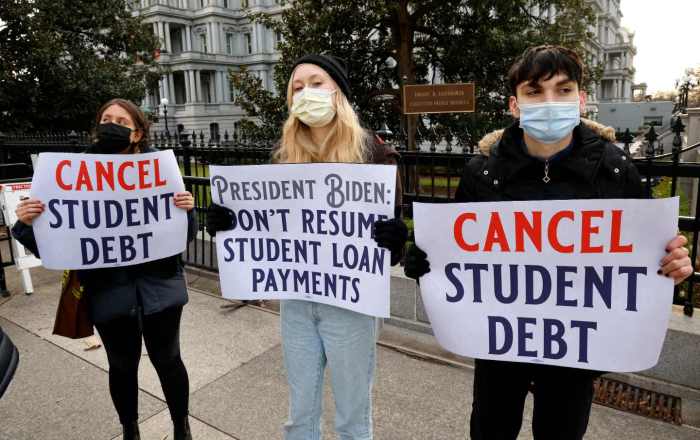
While student loan forgiveness has been a prominent topic of discussion, alternative solutions can also address the student loan crisis effectively. These alternatives focus on making repayment more manageable, providing opportunities for refinancing, and addressing the underlying causes of the crisis.
Income-Based Repayment Reforms
Income-based repayment (IBR) plans are designed to make student loan payments more affordable by basing monthly payments on a borrower’s income. However, these plans have limitations, such as long repayment periods and potential for accumulated interest. Reforms to IBR plans could address these issues by:
- Lowering the percentage of income used for payments:Currently, borrowers on IBR plans may be required to pay up to 15% of their discretionary income towards student loans. Reducing this percentage would make payments more manageable for borrowers with lower incomes.
- Shortening the repayment period:IBR plans can stretch out repayment for decades, leading to higher interest accumulation. Reducing the maximum repayment period to 15 or 20 years would limit the potential for ballooning debt.
- Addressing interest capitalization:Interest capitalization occurs when accrued interest is added to the principal loan balance, increasing the total amount owed. Eliminating or limiting interest capitalization would make IBR plans more effective in reducing debt.
Loan Refinancing Programs
Refinancing allows borrowers to secure a new loan with lower interest rates, potentially reducing their monthly payments and overall debt burden. Government-backed refinancing programs could:
- Offer lower interest rates:By leveraging the government’s borrowing power, refinancing programs could offer lower interest rates than private lenders, making debt more affordable.
- Provide flexible repayment options:Refinancing programs could offer various repayment options, such as fixed or variable interest rates, shorter or longer repayment terms, and income-driven repayment plans.
- Target specific borrowers:Programs could be tailored to specific groups of borrowers, such as those with high debt burdens or those who have experienced financial hardship.
Comparison of Solutions
| Solution | Pros | Cons | Potential Impact |
|---|---|---|---|
| Loan Forgiveness | Immediate debt relief, boosts consumer spending | High cost to taxpayers, potential for moral hazard | Significant reduction in student loan debt, potential economic stimulus |
| Income-Based Repayment Reforms | More affordable payments, targeted assistance | Potential for long repayment periods, interest capitalization | Increased affordability, reduced default rates, potential for slower debt reduction |
| Loan Refinancing Programs | Lower interest rates, flexible repayment options | Limited availability, potential for higher interest rates for some borrowers | Reduced interest costs, increased affordability, potential for increased access to credit |
The Future of Student Loan Policy
The debate over student loan forgiveness has thrust the future of student loan policy into the national spotlight. With the Biden administration’s forgiveness plan facing legal challenges and the long-term economic impact of forgiveness still uncertain, policymakers are grappling with how to address the student debt crisis and shape the future of higher education financing.
Potential Policy Changes
The future of student loan policy is likely to be shaped by a complex interplay of political, economic, and social factors. Here are some potential changes to existing programs or the introduction of new policies:
- Increased Income-Driven Repayment (IDR) Program Participation: One potential avenue for reform is to increase participation in IDR programs, which tie monthly payments to borrowers’ income. This could involve streamlining enrollment processes, simplifying eligibility requirements, and providing more robust public awareness campaigns.
- Expansion of Public Service Loan Forgiveness (PSLF): The PSLF program, designed to forgive loans for public service workers after ten years of qualifying payments, has faced significant challenges, including restrictive eligibility criteria and complex administrative processes. Future policy changes could include expanding eligibility to a wider range of professions, simplifying the application process, and ensuring more consistent forgiveness for eligible borrowers.
- Increased Funding for Higher Education: Addressing the affordability of higher education through increased funding for colleges and universities could play a significant role in reducing student loan debt in the future. This could involve increased federal grants, scholarships, and other forms of financial aid, which could help reduce the need for student loans in the first place.
- Reforms to the Private Student Loan Market: Private student loans, which are not subject to federal regulations, can pose significant challenges for borrowers. Future policy changes could include introducing regulations for private student loans, such as standardized disclosures and interest rate caps, to protect borrowers from predatory lending practices.
Final Thoughts
The debate surrounding student loan forgiveness is likely to continue for years to come, as policymakers grapple with the complex economic, social, and political implications of this issue. While forgiveness may offer a lifeline to struggling borrowers, it also raises concerns about its long-term sustainability and potential impact on the economy.
Ultimately, finding a comprehensive solution to the student loan crisis will require a multifaceted approach that addresses the root causes of the problem and provides meaningful relief to borrowers while ensuring fiscal responsibility.