The pursuit of higher education is often accompanied by a financial hurdle, and private student loans have become a common solution for many. These loans offer a lifeline for students seeking to bridge the gap between their educational aspirations and their financial resources.
But as with any financial instrument, private student loans come with their own set of complexities and considerations. This comprehensive guide will demystify the world of private student loans, providing insights into their intricacies and helping you navigate the path to responsible borrowing.




From understanding the different types of private student loans available to navigating the application process and managing your debt responsibly, this guide will equip you with the knowledge to make informed decisions about your financial future. We’ll explore the advantages and disadvantages of private student loans, delve into interest rates and repayment options, and offer strategies for minimizing risk and maximizing your financial well-being.
Introduction to Private Student Loans
Private student loans are a type of loan that can be used to finance education expenses, such as tuition, fees, books, and living expenses. They are offered by private lenders, such as banks, credit unions, and online lenders. These loans are not backed by the federal government, meaning they don’t offer the same protections or benefits as federal student loans.Private student loans can be a helpful option for students who have exhausted their federal loan options or need additional funding for their education.
Situations Where Private Student Loans Might Be Necessary
Private student loans can be useful in several situations, such as:
- When federal loans are insufficient to cover all educational expenses. This can occur when the cost of attendance is high, or the student’s federal loan limits have been reached.
- When the student has a poor credit history. Federal student loans typically have more lenient credit requirements than private loans. If a student has a low credit score or limited credit history, they may not qualify for federal loans but might be eligible for a private loan.
- When the student is pursuing a degree that is not eligible for federal student loan funding. Certain programs, such as graduate degrees, may not be eligible for federal loans, making private loans the only option for financing.
Differences Between Federal and Private Student Loans
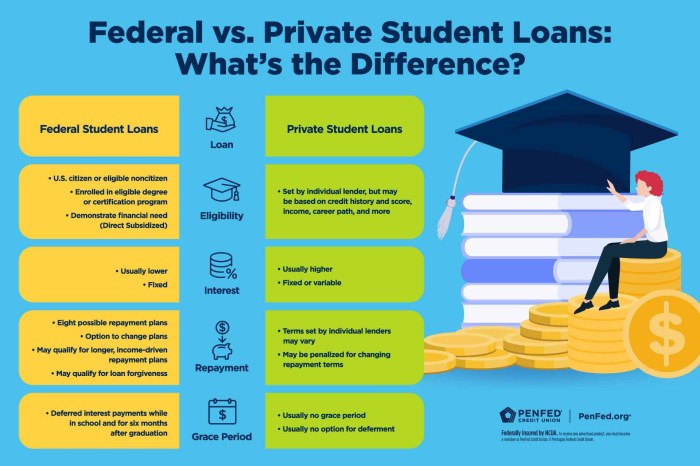
There are several key differences between federal and private student loans. These differences are crucial to consider when deciding whether a private loan is the right choice.
- Interest Rates:Federal student loans typically have lower interest rates than private loans. This is because federal loans are backed by the government, which lowers the risk for lenders. Private loans often have variable interest rates that can fluctuate over time, potentially leading to higher overall costs.
- Repayment Options:Federal student loans offer a variety of repayment options, including income-driven repayment plans and loan forgiveness programs. Private loans generally have more limited repayment options, and they may not offer income-driven repayment or forgiveness programs.
- Borrower Protections:Federal student loans have borrower protections that are not available with private loans. For example, federal loans offer deferment and forbearance options, which can temporarily pause or reduce loan payments. Private loans may not offer these protections, or they may have stricter eligibility requirements.
Types of Private Student Loans
Private student loans are a popular option for students who need to cover the cost of their education beyond what federal loans can provide. These loans are offered by private lenders, such as banks, credit unions, and online lenders. They can be a good option for students who have good credit, but they can also come with higher interest rates and less flexible repayment terms than federal loans.
Private student loans can be categorized into various types based on their eligibility criteria, interest rates, and repayment terms.
Types of Private Student Loans
Private student loans are available in various forms, each with its own set of features and benefits. Here is a breakdown of the most common types of private student loans:
| Loan Type | Eligibility Criteria | Interest Rates | Repayment Terms |
|---|---|---|---|
| Undergraduate Loans | Typically require a creditworthy cosigner, but some lenders may offer loans without a cosigner based on the borrower’s credit history. | Variable or fixed rates, generally higher than federal loans. | Repayment begins six months after graduation or when the borrower drops below half-time enrollment. |
| Graduate Loans | Similar eligibility criteria to undergraduate loans, but may require a higher credit score. | Variable or fixed rates, generally higher than undergraduate loans. | Repayment begins six months after graduation or when the borrower drops below half-time enrollment. |
| Parent Loans | Parents can borrow money to help their children pay for college. Eligibility criteria may vary by lender, but generally require good credit and income. | Variable or fixed rates, generally higher than federal loans. | Repayment terms vary by lender, but typically begin six months after graduation or when the borrower drops below half-time enrollment. |
| Refinancing Loans | Borrowers can refinance their existing student loans, including federal loans, to potentially lower their interest rate or monthly payments. | Variable or fixed rates, typically based on the borrower’s credit score and income. | Repayment terms vary by lender, but typically range from 5 to 20 years. |
Benefits of Private Student Loans
Private student loans can offer several benefits to borrowers, including:
- Higher loan amounts:Private lenders often offer higher loan amounts than federal loans, which can be helpful for students with high tuition costs or other educational expenses.
- More flexible repayment options:Some private lenders offer more flexible repayment options than federal loans, such as deferment or forbearance.
- Potential for lower interest rates:If you have good credit, you may be able to qualify for a lower interest rate on a private student loan than a federal loan.
Drawbacks of Private Student Loans
While private student loans can offer some benefits, they also come with some drawbacks:
- Higher interest rates:Private student loans typically have higher interest rates than federal loans, which can lead to higher overall borrowing costs.
- Less borrower protection:Federal student loans offer more borrower protections than private student loans, such as loan forgiveness programs and income-driven repayment plans.
- Credit score requirements:Private lenders often require borrowers to have good credit, which can be difficult for students who are just starting out.
- Cosigner requirements:Many private student loans require a creditworthy cosigner, which can put the cosigner at risk if the borrower defaults on the loan.
Interest Rates and Repayment Options
Private student loans offer various interest rates and repayment options, which can significantly impact your overall borrowing costs. Understanding these factors is crucial for choosing the loan that best suits your financial needs and circumstances.
Interest Rates
Private student loan interest rates are generally higher than federal student loan rates. This is because private lenders are not subject to the same regulations as the federal government. Interest rates vary based on factors such as your credit score, credit history, and the loan’s term.
- Fixed Interest Rates:With a fixed interest rate, your monthly payments remain the same throughout the loan term. This provides predictability and stability, allowing you to budget effectively.
- Variable Interest Rates:Variable interest rates fluctuate based on market conditions. While they may be lower initially, they can increase over time, leading to higher monthly payments.
Repayment Options
Private lenders offer a range of repayment options to accommodate different financial situations. These options may include:
- Standard Repayment:This is the most common repayment plan, with a fixed monthly payment over a set term, typically 10 to 15 years.
- Graduated Repayment:Graduated repayment plans start with lower monthly payments that increase over time. This can be beneficial for borrowers with lower incomes early in their careers.
- Income-Based Repayment (IBR):IBR plans tie your monthly payments to your income. This can be a good option for borrowers who anticipate a significant income increase in the future.
- Deferment:Deferment allows you to temporarily postpone your loan payments. This option is typically available during periods of unemployment, graduate school, or active military service.
- Forbearance:Forbearance is another temporary option that allows you to reduce or suspend your payments. It’s usually granted in cases of financial hardship.
Comparison of Private Student Loan Providers
| Lender | Interest Rates (Fixed/Variable) | Repayment Terms | Other Features |
|---|---|---|---|
| Lender A | 4.5%
|
5
|
Cosigner release, deferment, forbearance |
| Lender B | 4.0%
|
5
|
Income-based repayment, interest rate discounts |
| Lender C | 4.2%
|
5
|
Cash back rewards, early repayment discounts |
Choosing the Right Private Student Loan
Selecting the right private student loan can be crucial for managing your student debt and ensuring a smooth repayment process. It’s essential to compare different lenders and their offerings to find the best fit for your individual circumstances.
Explore the different advantages of Defaulted student loans that can change the way you view this issue.
Factors to Consider When Selecting a Private Student Loan
When choosing a private student loan, it’s important to consider several factors that can impact your overall borrowing experience. Here’s a checklist of essential aspects to evaluate:
- Interest Rates:Interest rates determine the cost of borrowing. Look for lenders offering competitive rates, as even a small difference in interest can significantly affect your total repayment amount over time. Compare fixed and variable interest rates, considering your risk tolerance and potential future interest rate fluctuations.
- Repayment Options:Different lenders offer various repayment options, including fixed monthly payments, graduated payments, income-based repayment plans, and deferment options. Evaluate which options best align with your expected income and financial goals. Some lenders may offer flexible repayment terms, such as the ability to make extra payments or adjust your payment schedule as needed.
- Fees and Charges:Pay close attention to any associated fees, such as origination fees, late payment fees, and prepayment penalties. These fees can add up over the life of the loan, so compare them across different lenders. Some lenders may waive certain fees, so it’s worth inquiring about potential fee waivers.
- Loan Terms:Consider the loan term, which determines the duration of your repayment period. Shorter loan terms typically result in higher monthly payments but lower overall interest costs. Longer loan terms can lower monthly payments but increase the total interest paid. Choose a loan term that aligns with your financial situation and repayment capacity.
- Cosigner Requirements:If you lack a strong credit history, some lenders may require a cosigner to guarantee the loan. A cosigner assumes responsibility for the loan if you default, so it’s essential to carefully consider the implications for both you and your cosigner.
If you do need a cosigner, look for lenders with cosigner release options, allowing the cosigner to be released from their obligation once you’ve established a strong credit history.
- Customer Service:A good lender should provide excellent customer service, readily available to answer your questions and address any concerns. Research the lender’s reputation for responsiveness and customer satisfaction. Consider reading reviews and testimonials from other borrowers to gauge their experience with the lender’s customer service.
- Transparency and Disclosure:Ensure the lender provides clear and transparent information about their loan terms, fees, and repayment options. Avoid lenders that use confusing jargon or hide crucial details in fine print. A reputable lender will be upfront and readily available to answer your questions about the loan process.
Comparing Private Student Loan Lenders
Once you’ve considered the factors mentioned above, it’s time to compare different private student loan lenders. You can use online loan comparison tools or websites to compare rates, fees, and other features.
- Interest Rates:Compare interest rates across different lenders and look for the lowest rates available. Remember to consider both fixed and variable interest rates, depending on your risk tolerance and future interest rate expectations. Some lenders may offer introductory interest rates that are lower for a specific period, but they often revert to a higher rate after that period.
Carefully evaluate the long-term interest rate implications before making a decision.
- Repayment Options:Compare the different repayment options offered by each lender, including fixed monthly payments, graduated payments, income-based repayment plans, and deferment options. Consider your expected income and financial goals to determine the most suitable repayment plan. Some lenders may offer flexible repayment terms, such as the ability to make extra payments or adjust your payment schedule as needed.
- Fees and Charges:Compare the fees associated with each lender’s loan, including origination fees, late payment fees, and prepayment penalties. These fees can add up over the life of the loan, so choose a lender with minimal fees or fee waivers. Look for lenders that offer transparent fee structures and clear explanations of each fee.
- Customer Service:Research each lender’s customer service reputation. Read online reviews and testimonials from other borrowers to gauge their experiences. Contact the lender directly with questions to assess their responsiveness and helpfulness. Choose a lender known for providing excellent customer service and resolving issues efficiently.
- Loan Terms:Compare the loan terms offered by different lenders, including the loan duration and any prepayment penalties. Consider your financial situation and repayment capacity when choosing a loan term. Look for lenders that offer flexible loan terms, allowing you to adjust the repayment period if needed.
Negotiating Loan Terms
While you may not have much leverage in negotiating interest rates with private student loan lenders, you can still explore ways to improve your loan terms.
- Shop Around:Compare offers from multiple lenders and use their competition to your advantage. If one lender offers better terms than another, you can use that information to negotiate with the other lender.
- Improve Your Credit Score:A higher credit score can qualify you for lower interest rates. Before applying for a loan, take steps to improve your credit score by paying bills on time, keeping credit card balances low, and avoiding opening too many new credit accounts.
- Consider a Cosigner:If you have a limited credit history, a cosigner with good credit can help you secure a loan with better terms. However, remember that a cosigner assumes responsibility for the loan if you default, so it’s crucial to have a thorough understanding of the implications for both you and your cosigner.
Legal Considerations and Borrower Protections
Private student loans are subject to a complex legal framework that Artikels the rights and responsibilities of both borrowers and lenders. Understanding these legal considerations is crucial for borrowers to protect their interests and navigate the loan repayment process effectively.
Borrower Rights and Responsibilities
Borrowers have specific rights and responsibilities under the law. These include:
- Right to Receive Clear and Accurate Loan Disclosures:Borrowers have the right to receive detailed information about the terms and conditions of their loan, including interest rates, fees, repayment terms, and any potential penalties for late payments. This information should be provided in a clear and understandable manner.
- Right to Understand Loan Terms:Borrowers should carefully review and understand the loan agreement before signing. They have the right to ask questions and seek clarification from the lender about any unclear terms or conditions.
- Right to Fair and Equitable Treatment:Borrowers have the right to be treated fairly and equitably by the lender. This includes protection from discrimination based on factors such as race, religion, or gender.
- Responsibility for Repayment:Borrowers are ultimately responsible for repaying their loans according to the agreed-upon terms. This includes making timely payments and adhering to the repayment schedule.
Consumer Protection Measures
Several consumer protection measures are in place to safeguard borrowers from unfair or deceptive lending practices. These measures include:
- The Truth in Lending Act (TILA):This federal law requires lenders to disclose specific information about loan terms, including interest rates, fees, and repayment terms, in a clear and concise manner.
- The Fair Credit Reporting Act (FCRA):This law protects consumers’ credit information and ensures accuracy in credit reports. It also gives consumers the right to access and dispute any inaccuracies in their credit reports.
- The Fair Debt Collection Practices Act (FDCPA):This law regulates the collection practices of debt collectors and prohibits certain unfair or abusive collection tactics, such as harassment or threats.
- State Laws:Many states have their own consumer protection laws that may provide additional protections for borrowers.
Dispute Resolution
If borrowers experience issues with their private student loans, they have several options for resolving disputes:
- Contact the Lender:The first step is to try to resolve the issue directly with the lender. Borrowers should contact the lender’s customer service department and explain their concerns.
- File a Complaint with the CFPB:The Consumer Financial Protection Bureau (CFPB) is a federal agency that oversees consumer financial products and services. Borrowers can file complaints with the CFPB if they believe they have been treated unfairly or have experienced deceptive lending practices.
- Seek Legal Assistance:If all other options fail, borrowers may consider seeking legal assistance from a qualified attorney. An attorney can help borrowers understand their rights and options and may be able to negotiate a resolution with the lender.
Final Summary
Navigating the world of private student loans can feel like traversing a labyrinth, but with the right information and a proactive approach, you can emerge with a clear understanding of your options and a solid plan for managing your financial obligations.
By carefully considering your needs, comparing lenders, and making informed decisions, you can harness the power of private student loans to achieve your educational goals while minimizing the potential risks. Remember, knowledge is your greatest asset in this journey, so equip yourself with the tools to make smart financial choices.